
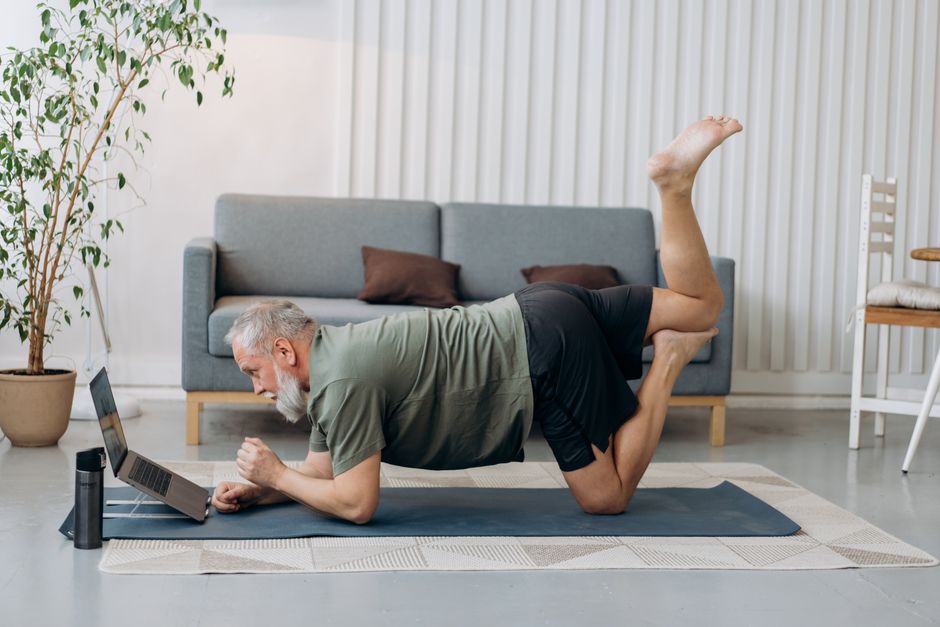
You’ve got 20 minutes, a patch of floor, and zero desire to buy a folding treadmill or a set of adjustable dumbbells that cost as much as a used car. Can you still build strength, improve endurance, and drop body fat? Yes — but only if you stop treating “no equipment” like a limitation and start treating it like a constraint that forces smarter programming.
Most bodyweight routines fail for one reason: they lack progressive overload. You do 20 push-ups, then 25, then 30, and eventually your shoulders stop responding. The fix isn’t more reps — it’s changing leverage, tempo, and exercise selection. This article gives you a repeatable 20-minute structure, names the exact mistakes that kill results, and tells you when a $15 yoga mat actually matters.
Why Bodyweight Routines Plateau (And How to Fix It)
Your muscles adapt to load within 4 to 6 weeks. If you do the same 10 exercises in the same order at the same speed, your nervous system becomes efficient — and your muscles stop growing. This is the plateau. It’s not a sign you need weights. It’s a sign you need variation.
The solution is threefold:
- Change leverage: Elevate your feet on a chair for push-ups. Shift to single-leg squats (pistol progressions). These increase the percentage of your body weight you’re lifting without adding a single pound of gear.
- Change tempo: Slow down the eccentric (lowering) phase to 4 seconds. A standard push-up becomes 2x harder when you control the descent. A squat becomes a quad-burner when you pause at the bottom for 2 seconds.
- Change volume distribution: Instead of 3 sets of 15, try 5 sets of 8 with 60-second rests. Higher density per minute forces metabolic stress, which drives muscle adaptation.
Most people never hit a real plateau — they hit boredom. They quit because the routine feels stale. The fix above solves both the physiological and the psychological problem.
The 20-Minute Routine: No Equipment, Full Body
This routine is built around a circuit structure. You perform each exercise for 40 seconds of work, then rest 20 seconds. After completing all 6 exercises, rest 90 seconds. Repeat for 3 total rounds. Total time: 19 minutes, 30 seconds.
| Exercise | Muscle Focus | Key Form Cue |
|---|---|---|
| Incline Push-up (hands on counter or chair) | Chest, shoulders, triceps | Keep elbows at 45 degrees, not flared |
| Bodyweight Squat | Quads, glutes, core | Knees track over toes, chest stays up |
| Reverse Lunges | Glutes, hamstrings, balance | Step back, not forward; front knee at 90 degrees |
| Plank Hold | Core, shoulders, glutes | Body in straight line from ears to ankles |
| Glute Bridge | Glutes, lower back, hamstrings | Squeeze glutes at top, hold for 1 second |
| Mountain Climbers (slow, controlled) | Core, hip flexors, cardio | Drive knee to chest, don’t bounce hips |
Progression rule: When you can complete all 3 rounds without breaking form, increase the work interval to 45 seconds or reduce rest to 15 seconds. Do not add reps faster than you can maintain control.
This circuit hits every major muscle group, keeps your heart rate elevated for fat burn, and requires exactly zero equipment. A yoga mat (like the Manduka PRO, about $120, or the Gaiam Essentials, about $20) helps with floor comfort for the plank and glute bridge — but a carpeted floor works fine.
Three Mistakes That Kill Home Workout Results
Most people fail at home workouts not because they lack discipline, but because they make avoidable errors. Here are the three most common, based on what I see in fitness forums and coaching logs.
Mistake 1: Training to failure every set. Taking every set to absolute muscular failure — where you can’t complete one more rep — increases injury risk and central nervous system fatigue. For bodyweight work, stop 1 to 2 reps shy of failure on most sets. Reserve failure for the final set of the final round.
Mistake 2: Ignoring the eccentric phase. Lowering yourself quickly during a push-up or squat robs you of 60 percent of the muscle-building stimulus. Slow eccentrics (3-4 seconds) create micro-tears that trigger repair and growth. If you’re not controlling the descent, you’re doing cardio, not strength training.
Mistake 3: No warm-up, no cooldown. Jumping straight into squats from a cold start tightens the hip flexors and reduces range of motion. A 3-minute warm-up — arm circles, leg swings, cat-cow stretches — adds 15 percent to your squat depth and cuts injury risk. A 2-minute cooldown with hamstring and quad stretches improves recovery.
If you make these three mistakes, it doesn’t matter how good your routine is. You’ll stall, get sore in the wrong places, and eventually quit.
When to Buy Minimal Equipment (And When Not To)
You don’t need equipment to get results. But some gear removes friction and unlocks exercises that bodyweight alone can’t replicate well. Here’s the honest breakdown of when a purchase makes sense.
Do NOT buy: Adjustable dumbbells (they cost $300-$600), a weight bench ($150+), or a cable machine ($500+). These are for people who have already maxed out bodyweight progressions and need linear load increases. If you can’t do 30 consecutive full push-ups or 50 bodyweight squats with perfect form, you don’t need these.
Consider buying:
- A yoga mat (Gaiam Essentials, $20). Adds grip and cushion for planks, bridges, and floor work. Worth it if you have hardwood or tile.
- Resistance bands (TheraBand CLX, $30, or Rogue Monster Bands, $40-$60). Add pulling exercises (band rows, band pull-aparts) that bodyweight can’t easily replicate. Great for back and shoulder health.
- A pull-up bar (Iron Gym, $30). Pull-ups are the single best upper-body pulling exercise. A doorframe bar lets you do negatives, isometric holds, and full reps.
The rule: buy only when the lack of equipment is the clear bottleneck to your progress, not when you’re bored with your routine. Boredom is fixed by changing the program, not by spending money.
How to Know If You’re Making Progress (Without a Scale or Mirror)
Progress with bodyweight training is harder to measure than with weights because you can’t just add 5 pounds to the bar. But there are measurable markers that tell you if you’re improving.
Rep count in a fixed time. Set a timer for 2 minutes. Do as many push-ups as you can with good form. Record the number. Retest every 4 weeks. Going from 25 to 35 is real progress. Going from 35 to 38 is maintenance. Going backward means you need more recovery or better nutrition.
Hold time for isometric exercises. A plank hold that goes from 45 seconds to 90 seconds is a 100 percent improvement in core endurance. Same for a wall sit or a glute bridge hold. These are objective, repeatable tests.
Perceived effort. If a circuit that felt “hard” (8 out of 10 effort) now feels “moderate” (5 out of 10), you’ve improved your cardiovascular efficiency and muscular endurance. This is subjective but reliable if you track it consistently.
Do not rely on the mirror or the scale. Bodyweight training changes body composition slowly — you might lose 2 pounds of fat and gain 2 pounds of muscle, which shows as zero change on the scale. Use the tests above instead.
The long-term outlook for home bodyweight training is better than most people think. With smart progression, you can maintain strength, manage weight, and improve mobility indefinitely — no gym membership, no equipment pile, no excuses. The routine above is a starting point, not a finish line. Adjust it, push it, and when it stops working, change the variables, not the method.
Medical Disclaimer: This content is for informational purposes only and does not constitute medical advice. Always consult a qualified healthcare professional before making health-related decisions.