

About 68% of people who buy home gym equipment stop using it within 90 days. That’s not a motivation problem — it’s a programming problem. The equipment sits idle because there’s no structured plan, no built-in progression, and no clear picture of how each piece fits into a weekly routine.
Six years of home training later, I’ve made most of the mistakes worth making. Here’s the guide I wish existed when I started.
The Equipment That Earns Its Floor Space
You need four things to run a complete strength program at home. Everything else is optional optimization that belongs in year two, not day one.
| Equipment | Cost | What It Covers | Worth It? |
|---|---|---|---|
| Adjustable Dumbbells | $300–$500 | Upper and lower body compound lifts | Yes — essential |
| Resistance Band Set | $20–$45 | Isolation work, cables, mobility | Yes — highest ROI piece |
| Adjustable Bench | $200–$350 | Flat, incline, and decline pressing | Yes — if you do any lifting |
| Doorframe Pull-Up Bar | $25–$60 | All back and bicep pulling | Yes — buy this first |
| Chest Press Machine | $600–$1,200 | Fixed-plane pressing only | No — a bench does more |
| Smith Machine | $800–$1,500 | Guided barbell movements | No — wrong tool for small spaces |
Best adjustable dumbbells right now
The Bowflex SelectTech 552 ($429) adjusts from 5 to 52.5 lbs in 2.5-lb increments using a dial that takes three seconds to change. For most people training upper body, that range covers two to three years of progression. If you want something with better long-term durability, the PowerBlock Elite EXP ($349) is what most serious home gym trainers prefer — the pin selector survives daily use far better than the SelectTech’s plastic dial.
What I skipped and don’t regret
Resistance machines. They train fixed movement patterns, occupy enormous floor space, and can’t replace the stability demands of free weights. A dumbbell and an adjustable bench do everything a chest press machine does, plus more. Sell yours or don’t buy one.
How to Structure Your Training Week
Training randomly — picking exercises based on what “feels right” — gives you inconsistency, skipped muscle groups, and zero progressive overload. A push/pull/legs split solves all three problems simultaneously.
- Day 1 — Push: Chest, shoulders, triceps — incline press, overhead press, lateral raises, kickbacks
- Day 2 — Pull: Back, biceps — pull-ups, dumbbell rows, face pulls, curls
- Day 3 — Rest or light walking
- Day 4 — Legs: Quads, hamstrings, glutes — goblet squats, Romanian deadlifts, lunges, glute bridges
- Day 5 — Full body or weak point focus: 4–5 exercises targeting what lagged during the week
- Days 6–7 — Rest
Four working sets per exercise. Eight to twelve reps per set. Rest 90 seconds between compound movements, 60 seconds for isolation work. Total session time: 45–55 minutes. Keeping it this simple is the point.
Progressive overload — the part most people skip
Track every session. Write down the weight and reps in a notebook or use the app Strong (free, iOS and Android). When you can complete the top of the rep range across all four sets, add weight or add a set the following week. Without this, your body adapts to a fixed stimulus after about six weeks and stops responding — regardless of how good the program looks on paper.
Resistance Bands Are Not Just Warm-Up Tools
Most people use bands for light activation before their “real” exercises and ignore them the rest of the session. That’s underselling them significantly.
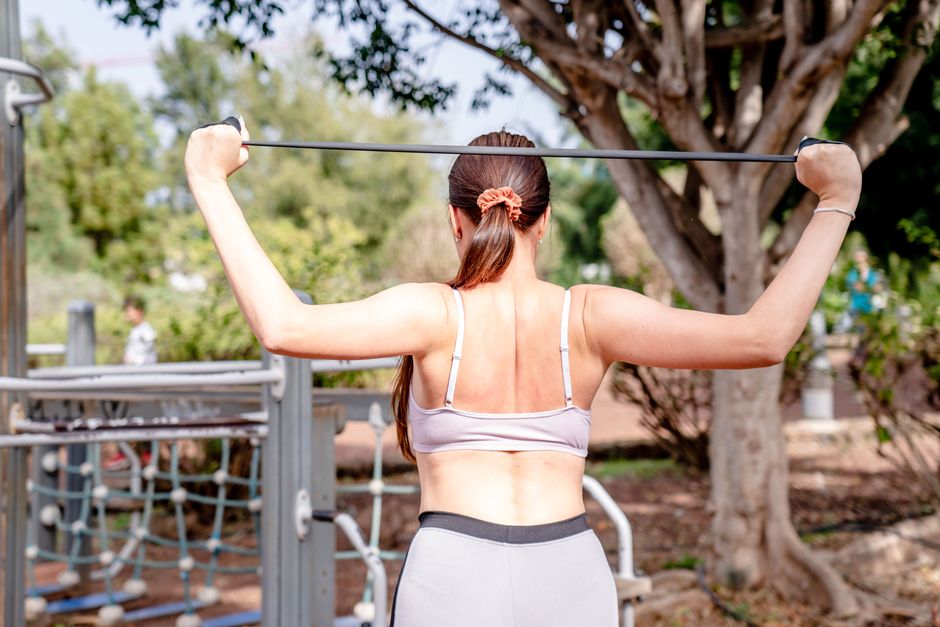
Bands provide variable resistance — tension increases as you stretch them. That’s a fundamentally different stimulus from dumbbells, which have constant load throughout the range of motion. For certain exercises, bands load the muscle harder at peak contraction than free weights can. Take lateral raises: anchor a band under your foot and the delt stays loaded throughout the entire movement, including the lowering phase. A dumbbell doesn’t do that.
Band exercises worth taking seriously
Face pulls: anchor a band at head height on a door frame, pull toward your face with elbows high. Three sets of 15–20 reps, three days a week. Single best shoulder health exercise for anyone who sits at a desk for hours daily.
Banded push-ups: loop a resistance band across your upper back and hold the ends in each hand. The band adds accommodating resistance at lockout — the same reason powerlifters use bands with bench press. The Letsfit Resistance Bands Set (~$25 on Amazon) includes five resistance levels and comfortable handles. Avoid the ultra-cheap single-loop bands — I’ve had two snap mid-exercise at the sewn seam.
Which bands to actually buy
For flat bands with handles: Letsfit at $25 is the right call for most people. For loop bands: the WOD Nation Monster Bands ($30 for a 4-pack) are the most durable I’ve tested over three years. Generic $10 sets lose tension unevenly after a few months and aren’t worth replacing every season.
Adjustable Dumbbells vs. Fixed Sets — Get Adjustable
This isn’t close. A fixed dumbbell set from 10 to 50 lbs costs $600–$900 and needs a rack the size of a small couch. The SelectTech 552 costs $429, sits on a stand about the size of a nightstand, and covers the same weight range. The only real argument for fixed dumbbells is that they never mechanically fail — which matters in a commercial gym, not in a spare bedroom. Buy adjustable and put the difference toward a bench.
The Full 4-Day Routine With Exact Sets and Equipment
This requires: adjustable dumbbells (5–52.5 lbs), a resistance band set, an adjustable bench, and a doorframe pull-up bar.
| Day | Exercise | Sets x Reps | Equipment |
|---|---|---|---|
| Push | Incline Dumbbell Press | 4 x 8–10 | Dumbbells + incline bench |
| Push | Standing Dumbbell Press | 3 x 10–12 | Dumbbells |
| Push | Banded Lateral Raises | 3 x 15 | Resistance band |
| Push | Tricep Kickbacks | 3 x 12 | Dumbbells |
| Pull | Pull-Ups | 4 x max reps | Doorframe pull-up bar |
| Pull | Single-Arm Dumbbell Row | 4 x 10 each side | Dumbbells + flat bench |
| Pull | Face Pulls | 3 x 15–20 | Resistance band (anchored high) |
| Pull | Hammer Curls | 3 x 12 | Dumbbells |
| Legs | Goblet Squat | 4 x 10–12 | Dumbbell + loop band above knees |
| Legs | Romanian Deadlift | 4 x 10 | Dumbbells |
| Legs | Walking Lunges | 3 x 12 each | Dumbbells |
| Legs | Weighted Glute Bridge | 3 x 15 | Dumbbell placed on hips |
How to scale this over 12 weeks
Weeks 1–4: learn the movements, don’t push to failure. Weeks 5–8: add one set to main compound lifts. Weeks 9–12: increase dumbbell weight one increment on exercises where you’ve consistently hit the top of the rep range for all sets. Twelve weeks of clear direction without needing to redesign anything.
Mistakes That Kill Progress Before It Starts
- Not tracking your lifts. Memory is unreliable after three sessions. Without written records, you repeat the same workout indefinitely and call it progressive training. A $2 notebook works fine.
- Skipping pull-ups because they’re hard. Do negatives instead — jump to the top position, lower yourself over five slow seconds. Every pull day. You’ll have 5 clean reps within four to six weeks.
- Overcomplicating the split. Six-day programs exist for people being paid to train. Four days with push/pull/legs is enough to build significant muscle in a year. Complexity is not progress.
- Buying equipment before mastering what you have. I bought a TRX HOME2 System ($200) before I could do 10 clean pull-ups. It collected dust for four months. Upgrades only help when you’ve genuinely outgrown your current setup.
- Treating rest days as wasted time. Muscle grows during recovery. Under six hours of sleep, testosterone drops and cortisol rises measurably. You will not make meaningful progress training hard on poor sleep, no matter how well-designed the program is.
The rep range trap
Staying in the same rep range forever. If you’ve been doing 3 x 12 for six months, try 4 x 6 with heavier weight for a month. The change in stimulus — not the change in exercises — is what breaks a plateau. The exercises can stay identical.
When Your Setup Needs a Real Upgrade
After six months of consistent training, two situations justify spending more money. First: you’ve maxed out your adjustable dumbbells. The SelectTech 552 tops at 52.5 lbs. When you’re regularly using that for compound lifts, you need heavier. The Bowflex SelectTech 1090 ($600) goes to 90 lbs — another two to three years of progression for most people.
Second: you want to barbell train. When dumbbell Romanian deadlifts and goblet squats no longer challenge you at any available weight, add a power rack. The REP Fitness PR-1000 Power Rack ($350) is the most space-efficient home option. Pair it with the CAP Barbell 110-lb Olympic Plate Set (~$150) and you have a complete barbell setup for under $550.
That’s a year-two purchase — only after the fundamentals are producing consistent results. Buying a power rack in week three solves a problem you don’t have yet.
Medical Disclaimer: This content is for informational purposes only and does not constitute medical advice. Always consult a qualified healthcare professional before making health-related decisions.